
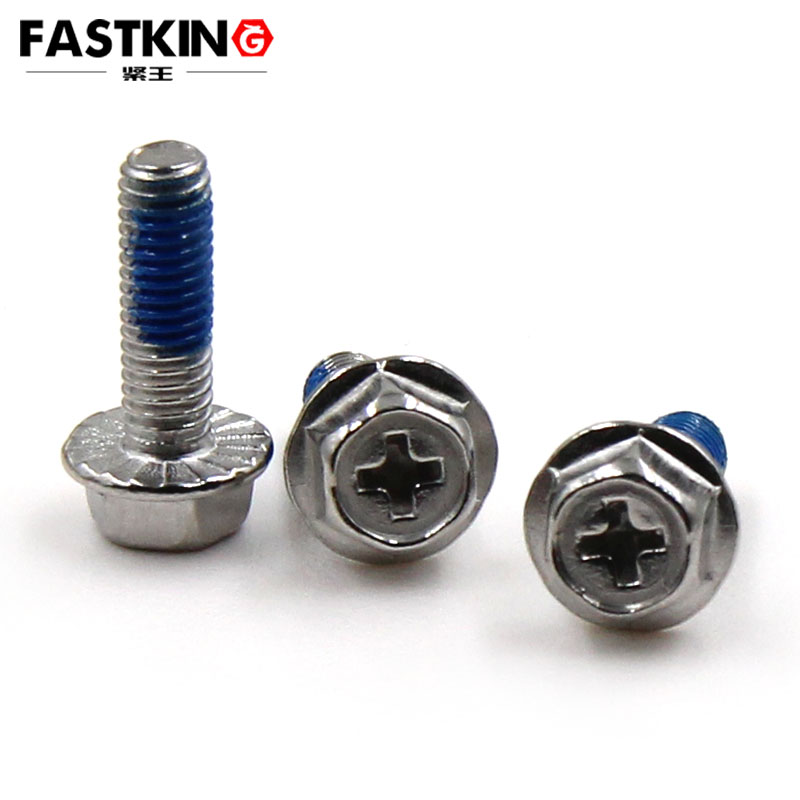
In fields such as industrial assembly, precision equipment and outdoor scenarios, the corrosion resistance, adaptability and operational convenience of fasteners directly determine the stability and service life of connections. The 304 hexagonal recessed cross flange toothed bolt integrates the corrosion resistance of 304 stainless steel, the dual-operation characteristics of hexagonal and cross slot, the adaptability of recessed design and the anti-slip function of flanged teeth. It is a special fastener that balances versatility and practicality, and is widely used in various scenarios with clear requirements for corrosion resistance and anti-slip performance. The following comprehensively analyzes the core value and practical points of this bolt from five aspects: core product characteristics, structural advantages, application scenarios, selection points and usage precautions, to help with accurate selection and standardized use.
The core competitiveness of the 304 hexagonal recessed cross flange toothed bolt lies first in the excellent performance of 304 stainless steel material. Made of standard 304 stainless steel, this bolt contains more than 18% chromium and 8% nickel in its chemical composition, with excellent corrosion resistance, heat resistance and processability. It has an austenitic structure and no magnetism at room temperature, and can maintain stable performance in ordinary atmosphere, humid environment and mild acid-base environment, not easy to rust or corrode. Without additional complex surface treatment, it can achieve basic anti-rust protection only by its own passive film. Compared with ordinary carbon steel bolts, its service life is greatly extended, especially suitable for scenarios requiring cleanliness and corrosion resistance. At the same time, 304 stainless steel has good toughness and processability, which can be accurately made into complex structures such as recessed head, cross slot and flanged teeth, balancing strength and adaptability. Its nominal tensile strength can reach about 520MPa, and yield strength is about 205MPa, meeting the needs of most conventional load scenarios and avoiding the hidden danger of deformation or fracture during long-term use.
In terms of structural design, this bolt integrates multiple advantages, and each design is in line with practical needs, different from ordinary fasteners. The hexagonal head design is convenient for wrench clamping operation, enabling quick tightening and disassembly, with uniform force to avoid slipping during operation. It is suitable for manual assembly and automatic mass production, adapting to grade A and B precision requirements, and performing excellently in scenarios with high assembly precision requirements; compared with flat head structure, the recessed head design makes the head more fit the workpiece surface, reducing the protrusion after installation, adapting to assembly scenarios with narrow space and requirements for surface flatness, and avoiding head collision damage to improve assembly aesthetics and safety; the cross slot design can be used with a cross screwdriver, making up for the limitation of insufficient operation space of hexagonal wrench, realizing dual-mode operation, adapting to complex installation environments, especially suitable for narrow spaces where wrenches are inconvenient to use; the flange is equipped with anti-slip teeth, no need for additional washers, which can effectively disperse fastening pressure, protect the workpiece base material from being crushed, and enhance the friction with the workpiece contact surface, greatly improving anti-slip and anti-loosening performance. It is especially suitable for scenarios with frequent vibration, avoiding bolt loosening and failure during working conditions. At the same time, the toothed flange design further improves the transverse bearing capacity, making it more stable in dealing with slight transverse loads.
Based on the dual advantages of material and structure, the application scenarios of this bolt cover many fields, accurately matching the corrosion resistance and anti-slip requirements of different working conditions. In the field of food processing equipment, 304 stainless steel material is odorless and pollution-free, can resist corrosion from acid and alkali substances in food, is suitable for connecting equipment body and conveying parts, and meets the cleanliness standards of the food industry; in the field of electronic equipment and home appliances, its compact structure and dual-operation mode are suitable for fixing precision parts and shells. The recessed head design does not affect the flatness of the equipment appearance, and the corrosion resistance of 304 material can avoid rust in humid environments, protecting the safety of electronic components; in the field of outdoor construction and decoration, it can be used for connecting curtain walls, doors and windows, guardrails and other parts. 304 material can resist wind and rain erosion in outdoor environments, and the anti-slip performance of toothed flange can cope with outdoor vibration and wind load, avoiding connection loosening, and no frequent maintenance is needed; in the field of chemical industry and medical equipment, it is suitable for equipment connection in mild corrosion environments. The corrosion resistance of 304 material can resist chemical medium erosion, ensuring long-term stable operation of equipment and meeting industry safety standards; in addition, in the field of furniture assembly and light machinery, it has strong versatility and convenient operation, can meet conventional connection needs, and balances practicality and economy.
When selecting and using, it is necessary to focus on details to ensure the best performance of the product and avoid connection failure caused by improper selection and irregular operation. In terms of selection, first, it is necessary to match the thread specification, clarify the pitch and bolt length, and ensure that it is completely consistent with the supporting nut and workpiece thread. Commonly, it is metric fine thread with good self-locking performance, suitable for connecting thin-walled parts, avoiding failure to tighten or loosen due to thread mismatch; second, select the appropriate head size and flange size according to the installation space, ensure that the recessed head design fits the workpiece, and the toothed flange fits the workpiece contact surface, avoiding insufficient space or poor fit; at the same time, confirm the demand according to the working condition environment. If it is in a severe corrosion environment (such as coastal and chemical strong corrosion scenarios), additional passivation treatment can be matched to further improve corrosion resistance. If it is a scenario with frequent vibration, priority should be given to specifications with clear flange teeth and suitable size to enhance anti-slip effect; in addition, priority should be given to products that meet national standards (such as GB5789) to ensure that the material meets the standard and the size is accurate, avoiding problems such as tooth loss and unqualified material of inferior products. At the same time, grade A or B precision products can be selected according to the assembly precision requirements to adapt to different scenario needs.
Usage precautions are also crucial: first, before installation, clean the oil, impurities and rust on the workpiece connection surface to ensure that the toothed surface of the flange is closely attached to the workpiece, avoiding impurities affecting the anti-slip effect and connection firmness; second, avoid over-tightening during operation, follow the standard torque to prevent thread slipping and workpiece base material damage, and avoid cross slot wear affecting subsequent disassembly; third, for bolts long-term exposed to outdoor or humid environments, regularly check the surface condition. If the passive film is damaged or slightly rusted, simple cleaning and passivation treatment can be carried out, and replace in time when severely rusted; fourth, avoid long-term contact with dissimilar metals to prevent electrochemical corrosion and affect service life; fifth, store in a dry and ventilated environment, avoid humidity and exposure to the sun, and prevent damage to material performance.
In summary, relying on the corrosion resistance of 304 stainless steel, the practical convenience of multi-structure integration, as well as the characteristics of anti-slip and strong adaptability, the 304 hexagonal recessed cross flange toothed bolt has become a high-quality fastener that balances corrosion resistance, convenience and stability. Whether in fields such as food and electronics that require clean corrosion resistance, or scenarios such as outdoor and vibration that require anti-slip and stability, it can be accurately adapted to provide reliable connection guarantee for the stable operation of equipment and structures. Reasonable selection and standardized operation can not only maximize its service life, but also improve assembly efficiency and connection safety.