
I. Structural Analysis
1. Head Design
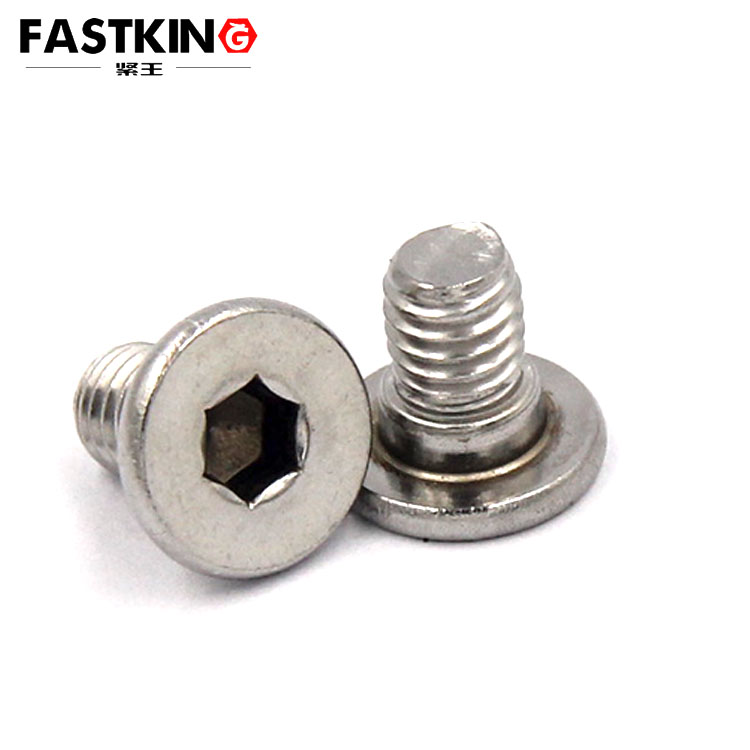
The pan head features a rounded upper profile and a flat underside, offering the following advantages:
- Aesthetic Appearance: The smooth, rounded curve is ideal for exposed installation and enhances product finish.
- Stress Distribution: The rounded transition reduces stress concentration at the head, lowering the risk of fracture.
- Large Tool Contact Area: The hexagon socket drive provides a larger torque-transmission surface.
2. Hexagon Socket Drive
Compared with cross recess drives, the hexagon socket drive offers:
- High Torque Transmission: Uniform force distribution over the hexagonal contact surfaces prevents cam-out.
- Excellent Reusability: Maintains reliable drive performance even after repeated assembly and disassembly.
- Flexible Installation Space: The wrench can be inserted from multiple angles, making it suitable for confined spaces.
II. Shoulder Structure (Core Feature)
1. The unthreaded shoulder is the core design of a shoulder screw:
- Precise Positioning: The shoulder diameter matches the mounting hole for accurate component location.
- Shear Resistance: The unthreaded shoulder bears shear loads, protecting threads from excessive force.
- Thread Protection: The shoulder makes contact first during assembly, preventing thread damage from impacts.
- Clamping Force Control: Shoulder height defines the clamping thickness, avoiding over‑ or under‑tightening.
2. Threaded Section
- Standard Pitch: Complies with ISO / DIN / GB standards for high interchangeability.
- Thread Length: Designed based on clamping requirements, typically 40–60% of total length.
- End Treatment: Flat end or slight chamfer to ease thread entry into the tapped hole.
III. Core Selection Factors
1. Dimensions
表格
| Parameter | Selection Guidelines |
|---|---|
| Thread Diameter | M3–M12 commonly used; determined by load requirements |
| Shoulder Diameter | Usually 0.5–1 size larger than the major thread diameter |
| Shoulder Length | Equal to the total thickness of the clamped components |
| Overall Length | Shoulder length + thread engagement length (≥ 1.5 × thread diameter) |
2. Material Selection
表格
| Material | Strength Class | Application Scenarios |
|---|---|---|
| Carbon Steel 1022 | Class 8.8 | General machinery, indoor equipment |
| Alloy Steel 40Cr | Class 10.9 / 12.9 | High-load, high-vibration environments |
| 304 Stainless Steel | A2-70 | Corrosion-resistant applications, food machinery |
| 316 Stainless Steel | A4-80 | Chemical, marine environments |
| Titanium Alloy | High strength, lightweight | Aerospace, medical devices |
3. Tolerance Fit
Fit accuracy between the shoulder and mounting hole directly affects positioning performance:
- Clearance Fit (H8/g7): Enables fast assembly, suitable for mass production.
- Transition Fit (H7/js6): High positioning accuracy, ideal for precision equipment.
- Interference Fit: Requires press‑fit installation; highest precision but difficult assembly.
4. Surface Finish
- Zinc Plating: Basic corrosion protection, low cost, suitable for indoor use.
- Nickel Plating: Good appearance, higher corrosion resistance than zinc plating.
- Black Oxide: Subtle, clean look; suitable for optical equipment.
- Dacromet: Superior corrosion resistance, hydrogen‑embrittlement free; ideal for automotive components.
- Passivation: Stainless steel exclusive; improves corrosion resistance.
IV. Typical Applications
- Precision Instruments: Shoulder positioning ensures accurate mounting of optical components and sensors, avoiding thread‑induced stress that impairs measurement accuracy.
- Automotive Manufacturing: Used in engine assemblies, transmission housings, suspension systems, and other parts subject to high vibration and shear loads.
- Electronic Equipment: Server chassis, communication base stations, power modules; the shoulder design enables quick alignment during installation.
- Mold Industry: Template positioning, slide block fixing; the shoulder withstands mold opening/closing impact and protects threads.
- Robot Joints: Combines high-precision positioning with high hexagon socket torque for reliable joint connections.
V. Selection & Installation Notes
- Shoulder Length Tolerance: Recommended within ±0.1 mm. Excessive length prevents proper clamping; insufficient length eliminates location function.
- Hole Design: Mounting hole diameter must match shoulder diameter with appropriate clearance.
- Tightening Sequence: For multiple screws, tighten crosswise and diagonally to ensure uniform loading.
- Locking Measures: In vibrating environments, use spring washers, thread locker, or locking nuts.
- Lubrication: Apply a small amount of lubricant during high-torque installation to reduce friction coefficient variation.
VI. Conclusion
Pan head hexagon socket shoulder screws integrate positioning, fastening, and limiting functions, making them ideal for precision assembly. Scientific selection requires balancing dimensions, material, fit, surface finish, and actual working conditions to achieve the optimal solution.
As industrial manufacturing advances toward higher precision and efficiency, the value of shoulder screws continues to grow. Choosing the right screw builds a strong foundation for product quality and reliability.