
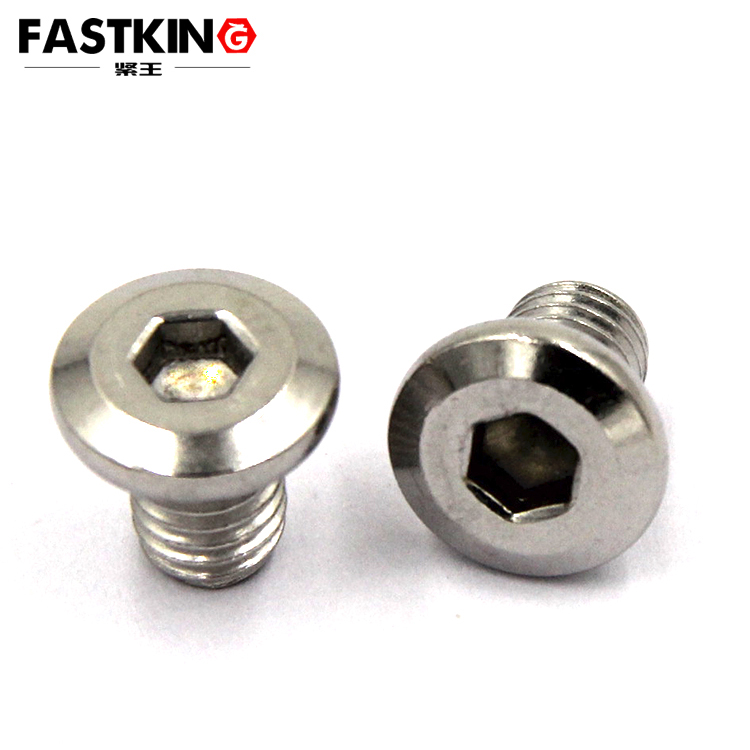
I. Structural Feature Analysis
1. Head Chamfer Design
The edge of the head of a countersunk hexagon socket screw is specially chamfered to form a smooth transition:
- Deburring Effect: Eliminates sharp edges on the head to prevent scratching operators or adjacent components.
- Aesthetic Improvement: The chamfer creates a rounded head profile, making it ideal for exposed installation in high-end equipment.
- Stress Optimization: Chamfering reduces stress concentration at the head edge and lowers the risk of cracking.
- Tool Insertion: The chamfer at the hexagon socket opening enables quick wrench insertion, improving assembly efficiency.
2. Hexagon Socket Drive
- Standard Hexagonal Hole: Complies with DIN 912 / ISO 4762 standards with precise across-flats dimensions.
- Hole Opening Chamfer: Guides smooth wrench insertion and reduces tool wear.
- Depth Design: Ensures sufficient torque transmission and prevents slippage or disengagement.
- Bottom Transition: Designed with a rounded or flat bottom to optimize stress distribution.
3. Thread End Chamfer
The screw tip is typically chamfered at 45°:
- Guiding Function: Facilitates thread entry into the tapped hole, especially for blind hole assembly.
- Thread Protection: Prevents deformation of the end threads from impact.
- Friction Reduction: The chamfered surface lowers initial screwing resistance.
II. Detailed Thread Parameters
1. Basic Thread Specifications
表格
| Specification | Pitch (mm) | Nominal Diameter (mm) | Minimum Tensile Strength |
|---|---|---|---|
| M3 | 0.5 | 2.98–3.00 | Class 8.8 / 10.9 |
| M4 | 0.7 | 3.98–4.00 | Class 8.8 / 10.9 |
| M5 | 0.8 | 4.98–5.00 | Class 8.8 / 10.9 |
| M6 | 1.0 | 5.97–6.00 | Class 8.8 / 10.9 |
| M8 | 1.25 | 7.97–8.00 | Class 10.9 / 12.9 |
| M10 | 1.5 | 9.97–10.00 | Class 10.9 / 12.9 |
| M12 | 1.75 | 11.97–12.00 | Class 10.9 / 12.9 |
2. Thread Tolerance Classes
- Class 6g: Standard tolerance for external threads, suitable for general assembly.
- Class 6h: Zero-deviation tolerance for higher fitting accuracy.
- Class 5g/6g: Precision fit for high-precision equipment.
3. Thread Form Parameters
- Thread Angle: Standard 60° triangular thread form.
- Crest Truncation: Truncated at H/8 to reduce stress concentration.
- Root Radius: Rounded transition with R = H/6 to improve fatigue strength.
- Effective Engagement Length: ≥ 1.5 times the thread diameter to ensure joint strength.
4. Mechanical Property Classes
表格
| Property Class | Min. Tensile Strength | Min. Yield Strength | Applicable Material |
|---|---|---|---|
| 8.8 | 800 MPa | 640 MPa | Medium carbon steel |
| 10.9 | 1000 MPa | 900 MPa | Alloy steel |
| 12.9 | 1200 MPa | 1080 MPa | Ultra-high-strength alloy steel |
| A2-70 | 700 MPa | 450 MPa | 304 stainless steel |
| A4-80 | 800 MPa | 550 MPa | 316 stainless steel |
III. Core Application Fields
Precision Machinery Manufacturing
Chamfered hexagon socket screws are used to secure key components in CNC machine tools, machining centers, precision instruments, and other equipment. The chamfered design avoids scratching precision surfaces, while the hexagon socket drive ensures high-torque fastening to meet equipment precision requirements.
Mold Industry
Injection molds, stamping molds, and template fixing and slider positioning extensively use chamfered hexagon socket screws. High-strength grades withstand mold opening and closing impacts, and the end chamfer enables fast blind-hole assembly, improving mold maintenance efficiency.
Automotive Manufacturing
Used in engine blocks, transmission housings, suspension systems, and other components, these screws endure high vibration loads. Class 10.9 / 12.9 high strength ensures reliable connections, and Dacromet surface treatment meets automotive corrosion resistance standards.
Electronic Equipment
In server chassis, communication base stations, power modules, and other electronic products, chamfered hexagon socket screws secure structural parts. The chamfered design prevents scratches to circuit boards and cables, with a clean appearance conforming to industrial aesthetic requirements.
Robotics Technology
For industrial robot joints, reducer fixing, end-effector connections, and other parts, these screws provide high-precision positioning and high-strength connections. They offer excellent repeated disassembly performance, suitable for equipment maintenance and upgrades.
Aerospace
Lightweight, high-strength chamfered hexagon socket screws are used for aerospace structural component connections. Made of titanium alloy or high-strength alloy steel with special heat treatment and surface protection, they meet aerospace-grade fastener standards.
V. Selection and Application Recommendations
- Strength Matching: Select Class 8.8 / 10.9 / 12.9 based on load conditions to avoid over-engineering or insufficient strength.
- Material Selection: Galvanized carbon steel for indoor use, stainless steel for corrosive environments, and alloy steel for high-temperature environments.
- Length Calculation: Effective thread engagement length ≥ 1.5 times the diameter, taking into account washers and clamped component thickness.
- Tightening Torque: Follow standard torque tables and use a torque wrench to avoid over-tightening and fracture.
- Locking Measures: Use spring washers, flat washers, or thread locker in vibrating environments.
- Lubrication: Apply lubricant during high-torque installation to reduce friction coefficient fluctuations.
VI. Conclusion
With its optimized structural design and reliable mechanical properties, the chamfered hexagon socket screw has become a mainstay in industrial fastening. It is widely used in applications ranging from precision instruments to heavy equipment, and from civil products to aerospace. A thorough understanding of its structural features, thread parameters, and application scenarios helps engineers make more scientific selection decisions, providing solid support for product quality and safety. In today’s manufacturing industry pursuing high precision and efficiency, the value of chamfered hexagon socket screws will continue to stand out.